


Product sorting
List of products


- 50 L, ultra flat, compact dimensions, possibility to connect two heat sources

Listing controls
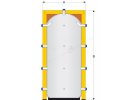
The use of multiple alternative energy sources for both the preparation of hot domestic water (HDW) and heating requires the installation of an accumulator tank connected to the heat sources. Heat can be obtained using solar collectors, a heat pump, a boiler, or by means of an electric heating element. The heat is then transferred by one or more heat exchangers. Heat accumulation ensures higher efficiency of the entire system.
Advantages of use:
- constant supply of hot water
- lower fuel consumption, the boiler operates at full capacity until the fuel is exhausted at optimal efficiency
- reduction of water heating costs
- increased comfort in hot water preparation
- extension of the boiler and other heat sources' lifespan
- ecological aspects
- use of hot water for other purposes (outdoor pool, greenhouse heating, etc.)
Accumulator tank for the boiler – pressurized accumulator tanks collect excess heat generated. This energy is stored for a certain period and used for heating the house or for heating hot domestic water when needed. If you heat more on a certain day, some rooms may become overheated and subsequently uneconomically ventilated. With the installation of an accumulator tank, the excess energy is stored and used later. The tanks have an insulating layer on the surface that ensures heat retention.
Sources of thermal energy:
- solid fuel boiler
- gas boiler
- heat pump
- solar panels
What size of accumulator tank?
When choosing the size of the tank, the main factor is the type of heat source and the performance of the entire heating system. It is also necessary to consider the size of the heated building and its heat losses. It is also important to consider how many people will use hot water. We offer tanks in various volumes. An improperly selected tank will not contribute to energy savings, quite the opposite. A small tank is insufficient in capacity, while on the other hand, an unnecessarily oversized tank is more expensive and the accumulated heat is not used properly. The general formula for calculating the volume is 50 L per 1kW.