
Gas and electric boilers
|
Protherm boilers
|
|
 |
 |


The gas condensing boiler is currently regarded as the most efficient type of boiler; its design and operating principle make it suited to the efficient heating of homes, offices and other buildings. It is compact and takes up little space.
It works in what is known as condensing mode, condensing the water vapour contained in the flue gases. A condensing boiler also makes use of the heat contained in the flue gases, which would otherwise escape through the flue. If the temperature of the flue gases in the boiler is lowered below the dew point (approx. 57°C for natural gas), the latent heat of condensation of the water vapour is released in the boiler's heat exchanger. The lower the temperature of the heating water entering the boiler, the more favourable the conditions for condensation.
The efficiency of a condensing boiler is proportional to the amount of condensate formed on the wall of the heat exchanger. The boiler is therefore most economical when connected to low-temperature heating systems (underfloor or wall heating) and when the water is heated using the modern principle of a stratified cylinder. A lower return water temperature at the boiler inlet allows more heat to be extracted from the condensate.
The boiler output depends on how much heat needs to be supplied to the living space to ensure thermal comfort. At low outdoor temperatures the boiler runs at a higher output; conversely, at higher temperatures far less output is needed. Output is controlled by what is known as boiler output modulation, which adjusts itself automatically on the basis of several input parameters.
The boiler should be able to regulate its output smoothly over the widest possible range. The greatest benefit of modern boilers is their ability to operate at maximum efficiency without the need for cycling. Weather-compensated control and speed control of the circulation pump are also available. The purpose of weather-compensated control is to prevent unnecessary heat losses through the surface of the boiler.
Types of condensing boilers:
Wall-hung condensing boilers are designed to be mounted on the wall. They provide either heating only, or heating together with domestic hot water.
They take up very little space and have an integrated, small-volume hot water cylinder.
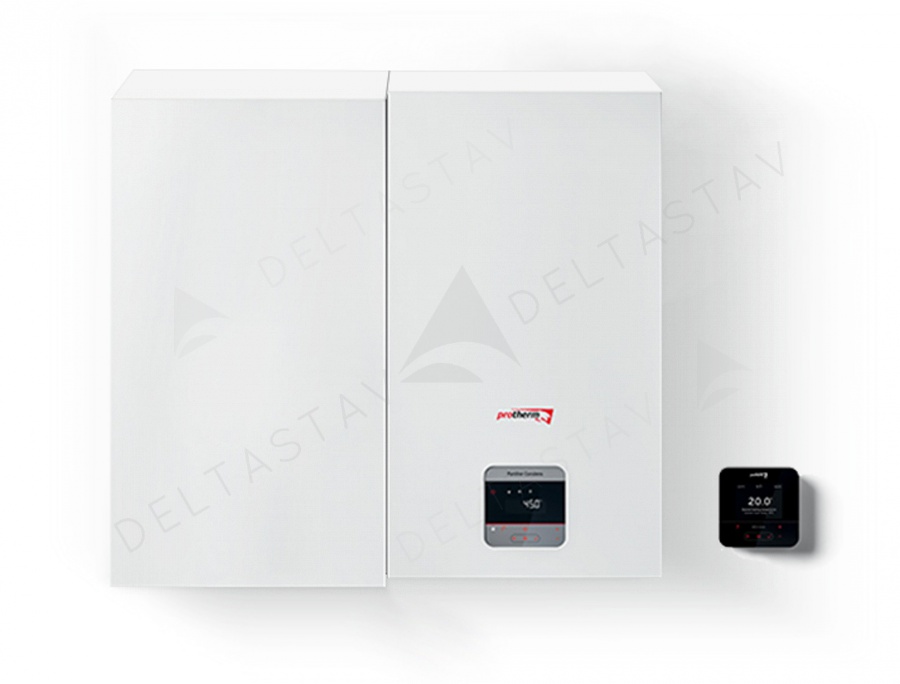
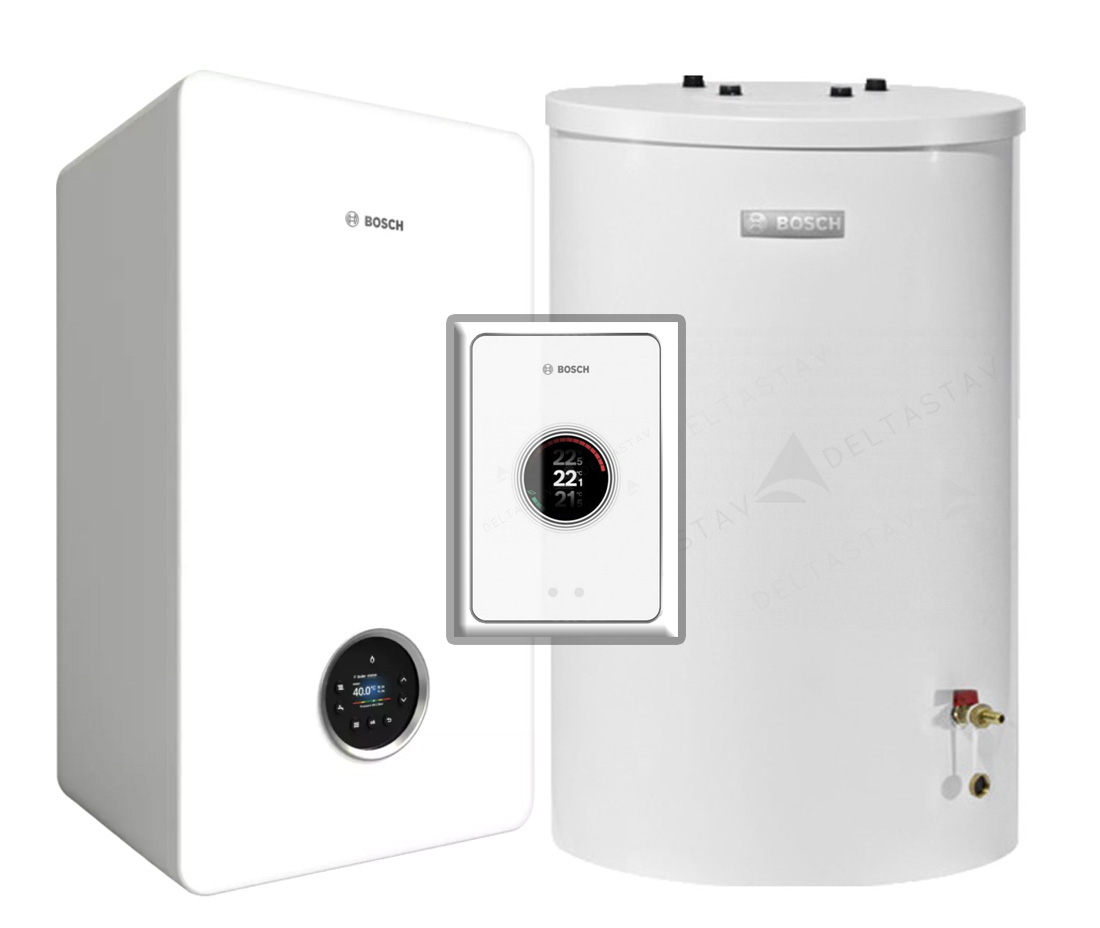
Condensing boiler packages are sets for heating and hot water with a separate cylinder positioned beside or beneath the boiler. They allow a hot water cylinder of larger capacity to be used.
Compact condensing boilers are condensing boilers suitable for family houses. A built-in hot water cylinder is an integral part of the unit.
The hot water is heated by the boiler itself, or additionally by a solar collector. They need more space because the boiler stands on the floor.
A condensing boiler on its own achieves 98% efficiency calculated from what is known as the gross calorific value. However, if the calculation takes into account the water vapour in the flue gases from natural gas, it contains a further 11% of heat. In this way a condensing boiler can theoretically achieve an efficiency of up to 109% compared with other boilers. By comparison, a condensing boiler operates at a maximum efficiency of up to 98%, low-temperature boilers operate at a slightly lower efficiency of up to 89%, and in last place are conventional boilers, whose efficiency is up to 84%.